At arrival
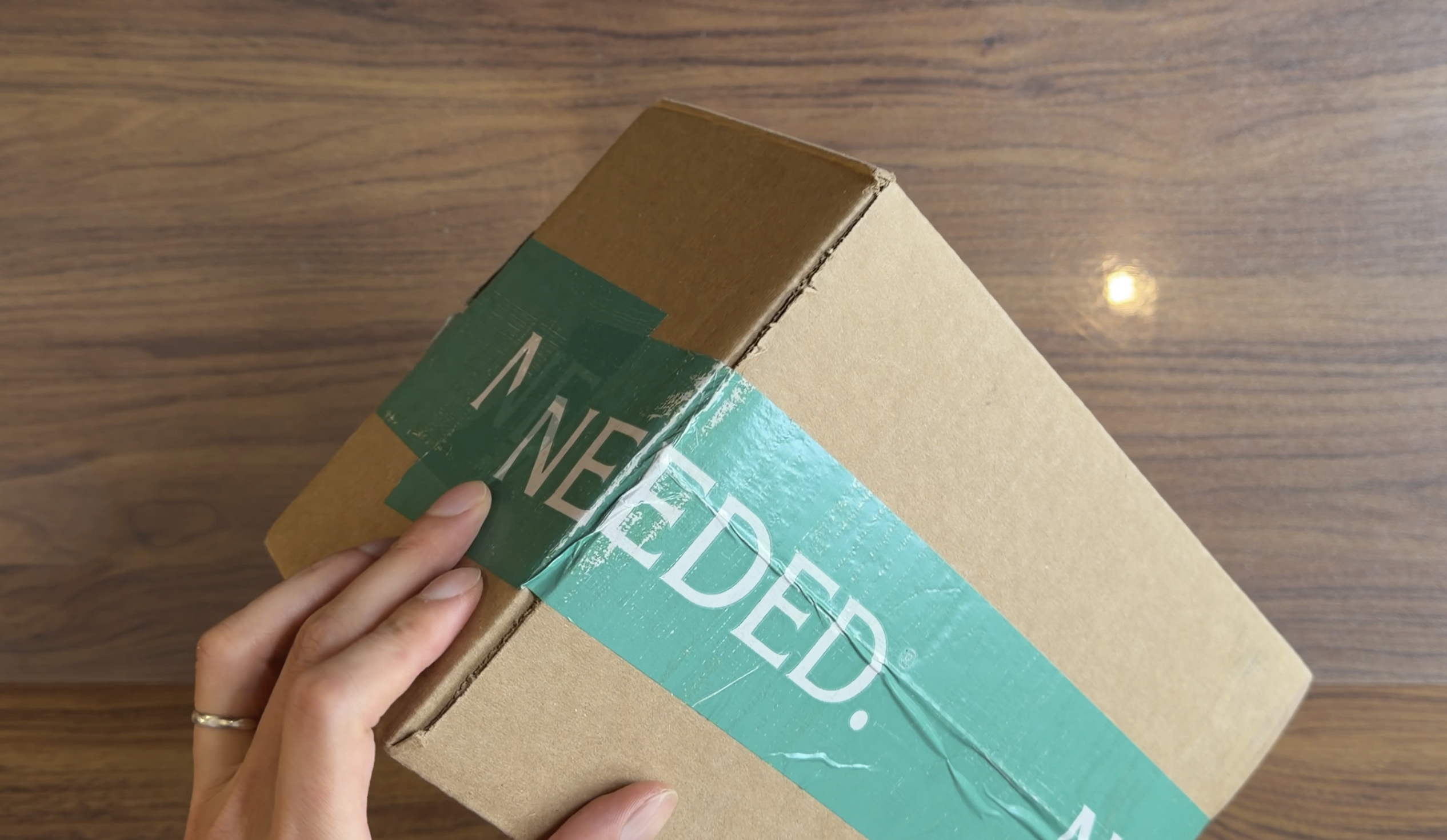
Branded tape worn after one journey
The tape is already scuffed and creased. On a plain carton, it weakens the first impression.


Here is a quick review from a current Needed customer to show how we look at the customer experience, packaging and shipping costs with brands.
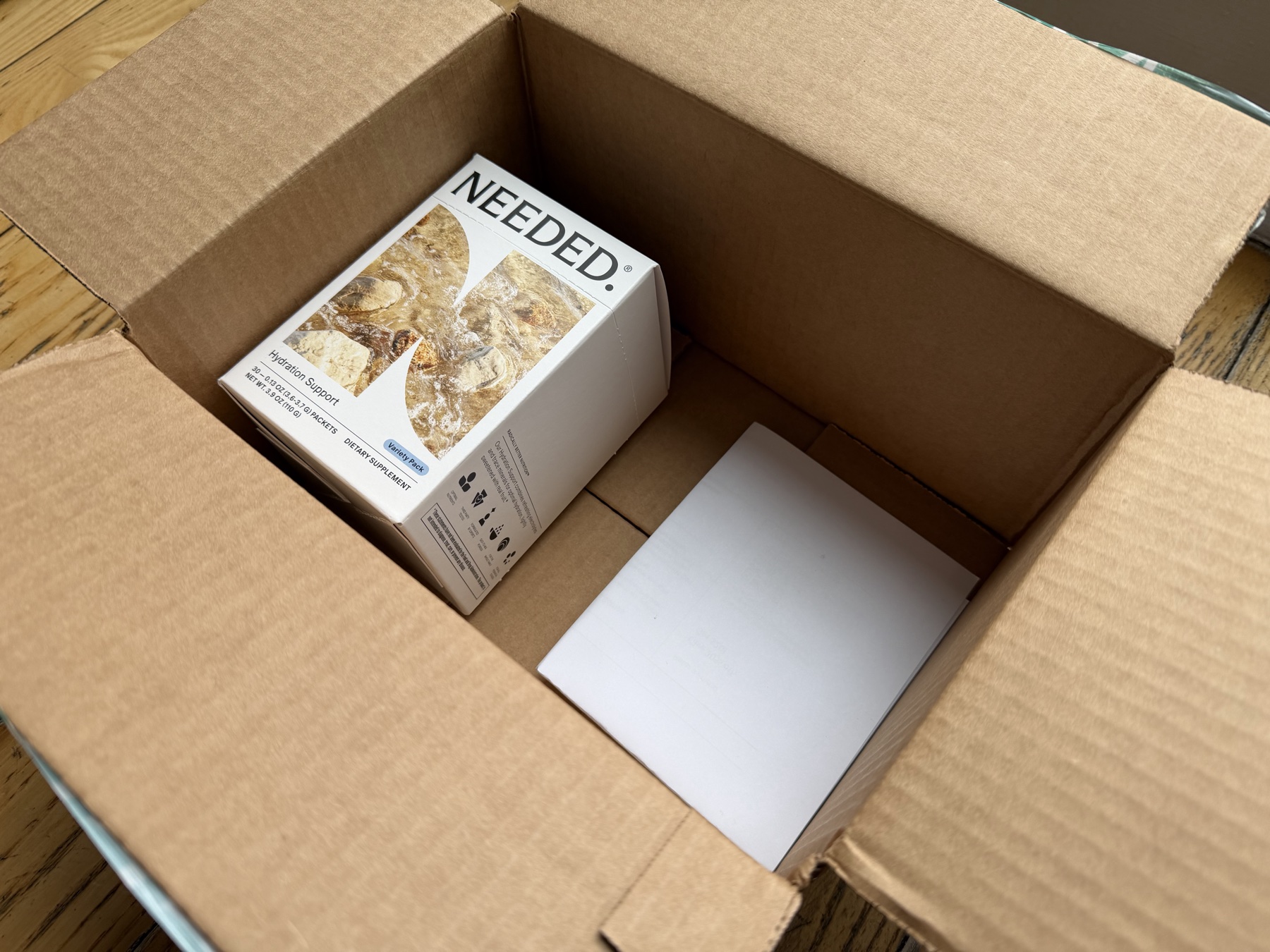
Shipping carton: 13.5 × 25.5 × 18.7 cm
Product: 8.7 × 13.3 × 9.4 cm
Approximate share of outer carton volume beyond the product box
Customer-provided weight, including a 4 oz carton and Geami dunnage
About 1.75 lb DIM versus 13 oz actual. The larger weight sets the tier; they are not added.
The product box is beautifully designed. Yet the shipment arrives in a plain stock carton with branded tape already worn after one journey. The extra space calls for Geami dunnage, so the unboxing begins with filler.
The tape is already scuffed and creased. On a plain carton, it weakens the first impression.
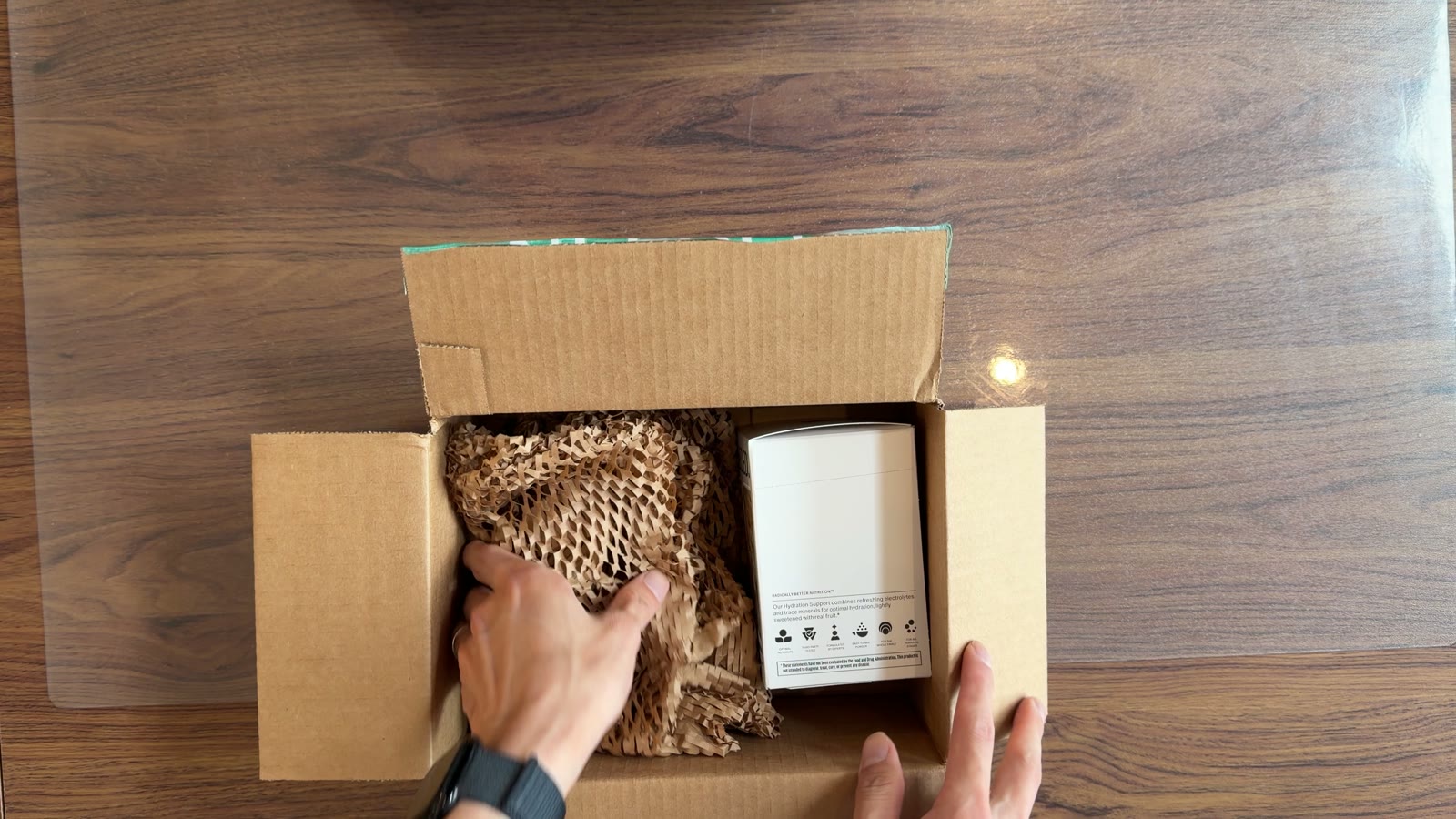
The filler takes up space created by the carton choice. A smaller shipper could remove that material and the step needed to add it.
One product box was delivered. A box from the prior month appears later only to demonstrate fit.
I am sharing a customer's perspective here, not packaging expertise. The print and finish look great. I am curious how others use the box, but its perforated opening left a loose flap on my counter, so I cut the flap off.
For this Needed order, a smaller branded carton could remove the Geami and its packing step. The $0.15 carton saving and $0.10 packing credit below are assumptions until we have Needed's prices and 3PL agreement.
per eligible single-product order if the 3PL removes the fill step from its fee
An added packing action can cost about $0.15–$0.20. We would target $0.10 back per order after removing Geami insertion. A branded box could improve arrival, while its material cost and any Geami savings need actual quotes.
In this Zone 5 example, the received carton moves a 13 oz parcel into the 2 lb rate bracket because of its size. A smaller carton sized around this product could bill at 11 oz. This scenario includes a proposed $0.10 packing credit and an assumed $0.15 carton saving.
| Component | Current carton | Smaller branded carton |
|---|---|---|
| Packaging and pack work | ||
| Carton purchase cost | Unknown | Assume $0.15 less Supplier quote needed |
| Geami material cost | Unknown Likely a few cents | $0 if removed |
| Geami pack action | Fee structure unknown | Seek $0.10 lower fee |
| Weight inputs | ||
| Monthly electrolyte product box | 7.5 oz | 7.5 oz |
| Shipping carton | 4 oz | ~2 oz About half the current box |
| Geami dunnage | ~1.5 oz | 0 oz |
| Actual parcel weight | 13 oz | ~9.5 oz |
| Parcel rate | ||
| Outer dimensions | 13.5 × 25.5 × 18.7 cm | 17 × 13 × 11 cm Hydration Support fit concept |
| Dimensional weight | ~27.9 oz / 1.75 lb | ~10.5 oz / 0.66 lb |
| Billable bracket Greater of actual or dimensional | 2 lb | 11 oz |
| Zone 5 example rate | $5.92 | $4.75 |
| Parcel rate difference | Baseline | $1.17 less |
| Plus pack-action credit | Baseline | $0.10 less |
| Plus assumed carton saving | Baseline | $0.15 less |
| Combined scenario difference | Baseline | $1.42 less |
The 7.5 oz product-box weight is the balance of the 13 oz parcel after the 4 oz carton and estimated 1.5 oz Geami. The proposed 2 oz carton, $0.10 fulfillment credit and $0.15 lower carton cost are assumptions. The 11 oz and 2 lb rate brackets use the measured dimensions without rounding each side up first. The carrier's dimension-rounding rule is unconfirmed and could change both brackets and the annual illustration. Geami purchase-cost savings remain excluded.
per eligible single-product order in Zone 5, including the assumed carton saving
The $1.42 combines $1.17 in parcel-rate difference, a proposed $0.10 packing credit and an assumed $0.15 lower carton cost. Actual 3PL charges and carton quotes could change the result.
For Equip, we found that 73% of more than 50,000 monthly orders could use a mailer. Our published case study models a $237,000 annual packaging opportunity. We would love to see whether a similar review could help Needed.
Read the Equip Foods case study ↗Rough Similarweb traffic estimates make a 40,000-plus monthly order scenario plausible for Needed. We use 40,000 as a planning assumption.
40,000 total orders × 30% single-item orders
12,000 orders × $1.42 × 12 months
Assumes all single-item orders can use this carton and receive the Zone 5 rate difference, packing credit and $0.15 carton saving. Needed's order volume, single-item share, package fit, actual charges and carton prices are unverified.
Customer photos and videos were recorded on 27 September 2026. The customer provided the carton dimensions and 13 oz parcel weight. The 4 oz current carton was also customer supplied; Geami weight of 1.5 oz remains approximate. “83% air” compares the outer volumes of the shipping and product boxes, rather than a measured empty-space fraction. The 7.5 oz product-box figure is calculated by subtraction. The proposed 17 × 13 × 11 cm carton and 2 oz weight are untested. The $0.10 fulfillment credit is a negotiation target. The parcel illustration uses Operating Crew's May 2026 UniUni rate reference for Zone 5 and a 225 cubic-inch-per-pound dimensional divisor. The card does not state whether each side is rounded before dimensional weight is calculated. Needed's Hydration Support page describes this product; its gummy and Omega-3 pages show other product formats. We found no published packed weight for this Hydration Support box or exterior package dimensions for the other items, so this carton is a single-product concept. The $0.15–$0.20 pack-action range is an Operating Crew working assumption supplied by Yan. The $0.15 lower carton cost is Yan's assumption, not a Needed price or supplier quote; the $1.42 per-order scenario is conditional on it and the proposed $0.10 packing credit. The Equip figures are drawn from Operating Crew's published case study. The rough traffic context comes from Similarweb's public Needed page; it does not establish an order count. The 40,000 monthly orders and 30% single-item share are Yan's assumptions. The annual figure further assumes every single-item order is eligible for this carton and the modeled Zone 5 charges. These figures are directional per-order estimates; actual invoices, unit costs and order mix would determine savings.